Showing posts with label British Writers. Show all posts

Wednesday, June 15, 2011

Dorothy Dunnett


"Facts are the soil from which the story grows.  Imagination is a last resort."


Scottish Novelist, Portrait Painter


1923 - 2001


A story should be rooted in reality.  The reader needs to be able to relate the characters to the world that he knows.  Consider the novel, Watership Down, by Richard Adams.  The story is about rabbits and yet, we identify with them because of their human characteristics.  Dorothy Dunnett was a writer of historical novels who did immense research to place her stories in historical reality.  But facts are never enough.  It is in the imagination that the story takes wings and flies far from the facts to spin a story that touches the minds and hearts of the readers.


Have you rooted your stories in the reality?  Have you used your imagination to carry the stories to the heavens?  How about your paintings?  Is there something in the work with which we can identify?  Does the painting carry us beyond the facts into another world?

Tuesday, May 31, 2011

Winston S. Churchill


Churchill, Age 26


"Success is stumbling from failure to failure with no loss of enthusiasm."


— Winston S. Churchill


British Artist, Historian, Writer and Statesman


1874 - 1965


Churchill painting (1946)


Churchill was a man who faced both failure and success multiple times throughout his life.  He did poorly in school, had a speech impediment, grieved the death of a child, smoked Havana cigars, and was captured and spent time as a prisoner of war in South Africa.  He wrote a novel, two biographies, three volumes of memoirs and several books of history.  He was awarded the Nobel Prize for Literature in 1953.  He painted hundreds of paintings and several now hang in museums.  He served as the Prime Minister of Great Britain twice.  So when Churchill speaks of failure and success we all should listen.


We all face both failure and success in our lives.  How we respond to what life hands us will tell others a lot about our character.  When you suffer the humiliation of defeat and rejection, how do you respond?  Do you become angry?  Do you seek revenge?  Do you withdrawal into depression?  When you receive some honor and are applauded by everyone, how do you respond?  Does the recognition go to your head and you become arrogant?  Do you act like a diva and expect everyone to do your bidding?  How we deal with the successes and failures of life tells us a lot about ourselves.


Daybreak at Cassis, near Marseilles
(1920)


Thursday, May 26, 2011

Robert Browning


"A moment's success pays for the failure of years."


English Poet


1812 - 1889


Success is short-lived and fleeting.  Success rarely makes you a better person.  The demons that haunted you when you were a failure still haunt you when you are a success.  In fact, success often makes the demons worse.  Success has even destroyed some creative leaders.  Yet, ask any writer, singer, actor or artist if those years of failure, hardship and poverty were worth that moment of success, and most will say yes.


Here is a poem by Robert Browning about two lovers sneaking out to meet each other late at night.


Meeting at Night


The gray sea and the long black land;

And the yellow half-moon large and low:

And the startled little waves that leap

In fiery ringlets from their sleep,

As I gain the cove with pushing prow,

And quench its speed i’ the slushy sand.


Then a mile of warm sea-scented beach;

Three fields to cross till a farm appears;

A tap at the pane, the quick sharp scratch

And blue spurt of a lighted match,

And a voice less loud, through joys and fears,

Than the two hearts beating each to each!


Sunday, May 15, 2011

Graham Greene


"Writing is a form of therapy; sometimes I wonder how all those who do not write, compose, or paint can manage to escape the madness, melancholia, the panic and fear which is inherent in a human situation."


British Novelist


1904 - 1991


Have you ever thought of your writing or your painting as a form of therapy, as a way to help you through the challenges you face in life with at least a part of your sanity?  This goes to the heart of who do we create for?  Ourselves or others?  I think the answer for the most part is ourselves.  If we write what others want us to write or paint what others want us to paint, I think we hurt ourselves more than help ourselves.  We all have demons in our lives that we must work through.  For some it is their childhood.  For others it is the death of someone they loved dearly.  For others it is the spiritual doubts they have.  Creating works of art helps us cope with the pain that is at the heart of our lives.  It helps us face the fears that try to force us into hiding.  It helps us to keep the madness at bay for a little while.

Monday, May 2, 2011

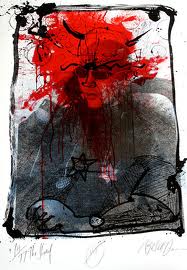
Ralph Steadman


"What I used to do with a passion, foolishly and vainly imagining I would change the world for the better, I no longer tolerate in myself or anyone else.  But draw, always draw — and WRITE."


British Artist, Writer


1936 -


Have you ever dreamed of changing the world — making it a better place?  Unfortunately, most people have very little influence on the world at large.  And with the one person that we do have influence over — ourselves — we usually lack the discipline for long-term change.  Have you ever tried to change a spouse or a significant other?  It rarely works.  I have often heard of wrecked marriages resulting from one person trying to change the other.


The Sheriff
1995


Revolution is often said to be the passion of youth.  And if one does not die in the revolution, one grows wiser with age.  If you study history, you will realize that even when the evil empire is overthrown, it is usually replaced by another empire that eventually becomes evil itself.  And the cycle continues.  The young want power and the old are unwilling to relinquish it.


And what you might add does all this have to do with art and writing?  Every generation or two there are revolutions in artistic taste and style.  The younger generation of artists challenges the older generation.  Today abstract expressionism is giving way to a resurgence of realism.  And tomorrow?  I won't even begin to predict.


I think Ralph Steadman has hit the nail on the head.  Stop worrying about changing the world, your spouse or even yourself.  Just create:  draw, paint and write. 

Sunday, April 24, 2011

Alan Watts


"Faith is, above all, openness; an act of trust in the unknown."


British Philosopher, Writer, Speaker


1915 - 1973


Creative leaders need faith in their talent and in their ability to find the answers to the problems they face in their artistic endeavors.  This requires being open to new ways of viewing the world — to believing the answer lies within the psychic.  Creative leaders must also trust the unknown.  


When you find yourself staring at a blank piece of paper or a blank canvas have the faith that you will fill it and complete your story, your poem or your painting.  You must have faith in yourself and trust that you have the skill and the talent to complete the work.  If you lose faith,  you will fail.


Do you have faith in yourself?  In your talent?  In your skill?  In your artistic vision?  Do you trust that you will produce the creative work that you are meant to produce?  Do you trust the unknown?


Listen to Alan Watts in this animation video.


Tuesday, April 12, 2011

Richard Wollheim


"Learning appears as a way of staying young, perhaps of staying alive, and also as a way of growing up, perhaps facing death."


British Author, Philosopher


1923 - 2003


Life-long learning is a powerful habit to develop.  Learning something new keeps us in touch with our youth and helps us to stay active and alive.  What have you learned in the last week?  Who has taught you something new about yourself or your art?  


We experience the world through our senses — hearing, seeing, tasting, touching and smelling.  And what we experience teaches us much if we are paying attention and alert to the possibilities.  Did you smell the wind today?  Did you hear the approaching storm?  Do you taste the rain on your face?


From the time we are born until we die, our purpose is to learn, to grow, and to change.  Most learning does not occur in school and we don't stop learning once we graduate.  Cultivate a learning attitude.  Unfortunately, many people do not learn from their mistakes.  They are not willing to change and grow.  To be a great artist or writer, you must be constantly learning about the world in which we inhabit.


And when we face death, it will teach us much that we have forgotten.  Do not be afraid of death.  Understand that it is a gift.  It is a door through which we pass, a gate that leads to another world.

Wednesday, March 23, 2011

A. S. Neill


"Take from others what you want, but never be a disciple of anyone."


Scottish Educator, Writer


1883 - 1973


Life is about learning and everyone we encounter, whether in the virtual world or the physical world, has something to teach us, but no one is the master of all knowledge and wisdom.  No one deserves our devotion or discipleship.  We need to each independently investigate truth for ourselves.  We need to come to our own conclusions.  If we choose to blindly follow one person, we have failed ourselves.  We have let ourselves down.


From time to time in my life, I have wished I knew someone who had all the answers and I could sit at his feet and soak in his wisdom.  But I have never encountered that person and I have had to depend on my own thoughts and wisdom.  I have had to learn to investigate what truth is for myself.  And sometimes I make mistakes and sometimes I get it right.


People often feel they need heroes and gurus.  They keep looking for THE answer.  We put people on a pedestal and when we discovered their actions don't match their words, we tear them down.  We punish them for leading us a stray.  What we fail to realize is that there are no perfect people — no wise men sitting on a hill, only fools trying to get by.


As artists and writers, we must be careful not to worship other artists and writers, not to put them on pedestals.  We need to independently investigate what they have to teach and then make our own choices.  Truth is a slippery slope.  What we believe to be true today we may discover tomorrow was an illusion.


For your listening pleasure, here is one of my favorite Beatles song:  Fool on the Hill.


Thursday, March 17, 2011

David Frost


"Don't aim for success if you want it; just do what you love and believe in, and it will come naturally."


British Journalist, Writer


1939 -


There is a paradox here.  If you seek success, you rarely find it.  If you do what you love, you will be successful even if it is not in the way that you imagined it.  As I grow older, I begin to define success less as money and fame and more as loving relationships.  The same is true of my artistic work.  It becomes less about the money and fame, then it is about the process of creating.


What is your passion?  What is your love?  Are you following your passion?  Are you doing what you love even if it is for only five minutes a day.  I dreamed for years of writing full time, but it was not to be.  But I have spent lots of hours writing.  The value is in the writing, the creating, not in doing it full time.  I challenge you to find 15 minutes every day to do what you love.  Don't wait until you can do it full time because it might never happen.  Do it now and success will follow.  Just be ready for the unexpected.  If life throws you a wrench when you are making other plans, just tighten the bolts and keep going.

Friday, March 11, 2011

Rudyard Kipling


"If history were taught in the form of stories, it would never be forgotten."


English Novelist and Poet


1865 - 1936


Do you love history?  Do you read history?  Or could you care less about history?  Do you incorporate history into your writing and paintings?  I believe creative leaders need to study history?  Artists should study art history and many do.  Writers should study the lives of writers.  English degrees tend to focus on the literature and studying the literature.  Writing degrees tend to focus on the writing.  But few writers study the history of writing, the history of writers, the history of words or the history of publishing.  I have met many wanna-be poets who haven't even read other poets. They would never consider studying the history of poetry.


But understanding literature, art and theater requires more than studying the history of the arts.  We need to study literature, art and theater in the context of the times they were created.  We need to study the social, political and economic histories.  We need to read biographies and memoirs. 


Writers, artists and actors are people of their times.  They creative works contain the same beliefs, hopes and biases that can be found in the rest of their society.  Novels written in other times and places will teach you one perspective of that society.  Their paintings are minature history books.


So I encourage you to read a biography of a favorite writer, actor or artist.  Immerse yourself in the history of another time and place.  What was Paris like during the time of the Impressionists?  What was New York like during the 1950's and the beats?


One of my favorite movies is The Man Who Would Be King, starring Sean Connery and Michael Caine, directed by John Huston and based on the novel by Rudyard Kliping.  The movie takes us to another place and time and gives us a glimpse of a world not our own.  Here are some scenes from the movie.


Wednesday, March 2, 2011

Sydney Smith


"Obstacles are those frightful things you see when you take your eyes off your goals."


English Writer, Anglican Clergy


1771 -1845


The reason many creative leaders don't reach their goals is that they are focused on the wrong thing.  People focus on all the reasons their feel they can't achieve their goals.  They need to focus instead on their goals. 


If you are focused on your goals, you will see over the obstacles, under the obstacles, around the obstacles and through the obstacles.  If you are focused on the obstacles, you will only see the obstacles and you will not achieve your goals.


What are your goals?  What are you focused on?  The obstacles?  Or the GOALS?  Banish the obstacles from your mind.  Focus on your goals.  Achieve your dreams.

Friday, February 25, 2011

Havelock Ellis


"Dancing is the loftiest, the most moving, the most beautiful of the arts, because it is no mere translation or abstraction from life; it is life itself."


British Physician, Writer, Psychologist


1859 - 1939


Dancing has never been my strong suit.  I grew up in a church where dancing was considered a sin.  I sinned in the seventh grade when I danced at a sock hop, but I have never felt comfortable dancing.  I have no rhythm. 


 I have learned that dancing is an art that touches the soul.  While I may never have rhythm, I can appreciate it in others.  I took a movement class 5 years ago that used movement to explore your purpose in life.  We created our life story through movement.  Some day I would like to participate in a workshop that combines dance, painting, storytelling and writing.  Who knows maybe I will create it myself. 

Thursday, February 17, 2011

William Makepeace Thackeray


"The world is a looking glass and gives back to every man the reflection of his own face."


— William Makepeace Thackeray


English Novelist


1811 - 1863


This is a very profound statement.  The world that we see is a reflection of ourselves.  I tell a story in my seminars about a little girl who lives in the mountains with her parents.  One day the little girl has a fight with her mother and she runs out of the house.  When she reaches the edge of the cliff, she stops and yells at the top of her voice: "I hate you.  I hate you."  To her surprise she hears a voice shouting back at her:  "I hate you.  I hate you."  This frightens the little girl and she runs back into the house and tells her mother that someone out there hates her.  Her mother realizing what happened tells her young daughter to go back outside and shout, "I love you."  The little girl tiptoes back outside and nervously tiptoes to the edge of the cliff.  She calls out: "I love you.  I love you."  Echoing back out of the valley, she hears the words, "I love you.  I love you."  The message is quite clear:  what we send out is what we get back.


What we expect to find in the world is what we find.  If we think the world is a negative hostile place where our competition is seeking to destroy us, we will find examples to prove our world view.  If we think the world is helpful and supportive, we will find examples to prove our vision of the world.  The world we see is a reflection of the person we are.  Have you looked in the mirror lately?  What kind of person do you see?

Monday, January 24, 2011

Samuel Taylor Coleridge


"Advice is like snow — the softer it falls, the longer it dwells upon, and the deeper it sinks into the mind."


English Poet


1772 - 1834


As creative leaders, we all receive advice — some good, some bad, and some dangerous.  Be careful of who you listen to.  The wrong advice can be damaging to your emotional and mental health as well as your creative output.  Good advice can keep you on track and motivated to keep producing creative work.  Dangerous advice is that which keeps us from fulfilling our potential.  We give up because some expert says we will never amount to anything.  


As creative leaders, we are also tempted to give advice.  Be careful.  The wrong advice can destroy a potential artist or writer.  I learned a valuable technique from a trainer many years ago.  He said if you are coaching someone on skill development, you should ask them two questions:  What did you do right?  and What will you do differently next time.


Most people know when they made a mistake or messed up, even if they don't consciously admit it.  And when they write or paint something, they are very critical of themselves.  So get them to focus on what they did right?  Have them focus on the good things.  Then ask them what they will do differently the next time they write a story or paint a picture?  Get the person to focus on how he can improve.   


Sunday, January 16, 2011

Douglas Adams


"I may not have gone where I intended to go, but I think I have ended up where I needed to be."


1952 - 2001


English novelist


When we are young, we have lots of dreams of what we want to do with our lives.  When I was in junior high, I wanted to be an architect.  My father was a general contractor and build over 300 houses in his lifetime so I am sure that was an influence on my dream.  But in recent years, I realize that I had as a child a desire to draw which no one encouraged.  When I was a sophomore in high school I made a commitment to be a minister.  By the time I was a senior in high school I had lost my faith in religion.  In college I dreamed of being a writer.  My life may not have turned out as I imagined, but I believe it turned out better and I became what I was meant to be.


I have spent more than 35 years writing poetry and short stories.  I have published 14 books and hundreds of poems.  I have spent over 20 years as a motivational speaker (ministry) touching people's hearts and souls.  And late in my life I have turned to painting masks.  I know I ended up where I needed to be and did what I needed to do.


I believe that we are all here on this earth to learn lessons and grow.  Everything that happens to us will teach us valuable lessons.  The choices we make will lead us down the roads we need to travel.  We will arrive where we are meant to be, having learned the lessons we were meant to learn.


When I was 50 I wrote an article, "What do I want to be when I grow up? Or how I found myself!", that appeared in my college alumni magazine.  In the article I describe how became what I was meant to be.

Monday, December 27, 2010

Dante Gabriel Rossetti


Self-Portrait, 1847


"Picture and poem bear the same relationship to each other as beauty does in man and woman:  the point of meeting where the two are identical is the supreme perfection."


English Poet and Artist


1828 - 1882


Lady Lilith, 1868


Having spent over 35 years writing poetry and now painting for the last five years, I am fascinated by the point where poetry and painting meet.  Dante Gabriel Rossetti was trained both as a poet and a painter and spent a lifetime writing poetry and painting pictures.  He once said: "If any man has any poetry in him he should paint it, for it has all been said and written."  And yet Rossetti saw himself more as a poet than a painter.  He also said: "Painting being — what poetry is not — a livelihood — I have put my poetry chiefly in that form."  And I would have to agree with his last point.  While it may be difficult to make a living being a painter, it is even more difficult making a living from writing poetry.  


Is there a poem inside you asking to be let out?  Is there a painting inside you begging to be set free?  I strongly encourage painters to write poetry and short stories.  I think every poet and novelist should pick up a brush and spend a few hours painting.  Remember it is not about being financially successful.  It is about releasing your inner creativity.


Here is a poem by Rossetti:


The Honeysuckle


I plucked a honeysuckle where


The hedge on high is quick and thorn,


And climbing for the prize, was torn,


And fouled my feet in quag-water;


And by the thorns and by the wind


The blossom that I took was thinn'd,


And yet I found it sweet and fair.


Thence to a richer growth I came,


Where, nursed in mellow intercourse,


The honeysuckles sprang by scores,


Not harried like my single stem,


All virgin lamps of scent and dew.


So from my hand that first I threw,


Yet plucked not any more of them.


Here is a video on YouTube showing some of the paintings of Rossetti:


Sunday, December 26, 2010

D. H. Lawrence


"All my life, I have from time to time gone back to paint because it gave me a form of delight that words can never give.  Perhaps the joy in words goes deeper and it is for that reason more unconscious.  The conscious delight is certainly stronger in paint."


English Novelist, Poet and Painter


1885 - 1930


Painting by D. H. Lawrence

Creative expression is not limited to one form.  Poets paint.  Painters write.  Actors paint.  What do you find joy in?  Words?  Paint?  Acting?  Don't limit yourself to one form or medium.  Explore and expand your horizons.  Creativity is open and free.  Perfectionism is narrow and limiting.  We sometimes don't try things because we want to be perfect.  Perfectionism is about technique.  Creativity is about expression.  If we allow ourselves to be confined by technique, our creativity will harden and shrink.  Creativity frees the soul and opens up new worlds.  Technique imprisons the soul and we die a slow death.  What do you take delight in?  What brings you joy?    

Sunday, November 21, 2010

Peter Ustinov


"The point of living, and of being an optimist, is to be foolish enough to believe the best is yet to come."


British actor/novelist


1921 - 2004


No matter what age you are, the best is yet to come.  No matter where you are in your career, the best is yet to come.  Each day we live provides us with new opportunities, new ways to grow and new things to learn.  Colonel Harlan Sanders was sixty-five when he opened his first Kentucky Fried Chicken restaurant.  Thomas Edison was sixty-seven when he reinvented the phonograph.  At seventy-seven, Grandma Moses began painting.  At eighty, Jessica Tandy won an Oscar for the film, Driving Miss Daisy.  Winston Churchill wrote A History of the English-Speaking Peoples at age 82.  Peter Ustinov acted in the movie, Luther, at age 83.  At ninety, Picasso was still producing drawings and engravings.  At age 93, P. G. Wodehouse was working on his 97th novel when he died.  Remember the best is yet to come.