Showing posts with label Wisdom. Show all posts

Thursday, July 14, 2011

John Cheever


"The need to write comes from the need to make sense of one's life and discover one's usefulness."


American Novelist


1912 - 1982


We all have a need to understand our lives and the things that happen to us.  Some turn to religion.  Others turn to history or politics or science.  Creative leaders turn to their art.  The stories we tell help us to make sense of who we are and why we are here.  And often we change the facts of our lives to tell a better story.  What stories are you telling in your artistic works?  How have you altered the facts of your stories to tell a greater truth?  


John Cheever is a perfect example of a writer who rewrote his life in his short stories and novels.  Born on May 27, 1912, John Cheever was the unwanted second child.  His father tried to convince his mother to have an abortion.  A storyteller from a young age, Cheever read Proust's In Search of Lost Time at the age of fourteen.  He dropped out of high school and never went to college.  He sold his first story to The New Republic at age 18.  For more than twenty years he published only short stories.  His first novel was not published until he was in his mid-forties.  In 1979 three years before his death, he won a Pulitzer Prize for a collection of his short stories that I highly recommend all creative leaders read.


Friday, July 1, 2011

Heinrich Heine


Painting of Heine
by Moritz Daniel Oppenheim


Wherever they burn books they will also, in the end, burn human beings."


German Poet


1797 - 1856


When a nation or society has no respect for its artists, writers and musicians, it is a nation in danger of losing its humanity.  I find it very sad that in this country where liberty is held in high esteem that there are people who choose to burn books.  When my daughter was in high school, she knew teenagers who participated in the burning of books with members of their church.  How ignorant these people must be.  Books are our connection to the world beyond our immediate home.  But it is not just in this country and it is not just books.  In 2001 when the Taliban were in power in Afghanistan, they destroyed two 1700 year-old Buddha statues carved in a cliff in the Hindu Kush mountains.  Other cultures have destroyed paintings.  And governments and societies have tried to control the type of art works that are created.  Both Hitler and Stalin restricted the type of art that could be created.


Artists, writers and musicians are one of the greatest treasures that a society has and yet people continue to treat them with contempt — telling them to get a real job.  In fact, the way we know about the past is through the artists, writers and the musicians.  We would know very little about ancient Rome or Greece if it were not for books and paintings.  Future societies will know us primarily through the writers and painters of today.  Our legacy is past down through our art.  


Here is a poem by Heinrich Heine.


WHY THE ROSES ARE SO PALE

by: Heinrich Heine (1799-1856)


       DEAREST, canst thou tell me why

      The rose should be so pale?

      And why the azure violet

      Should wither in the vale?


      And why the lark should in the cloud

      So sorrowfully sing?

      And why from loveliest balsam-buds

      A scent of death should spring?


      And why the sun upon the mead

      So chillingly should frown?

      And why the earth should, like a grave,

      Be moldering and brown?


      And why it is that I myself

      So languishing should be?

      And why it is, my heart of hearts,

      That thou forsakest me?


This English translation of "Why the Roses are so Pale" was composed by Richard Garnett (1835-1906).


Thursday, June 23, 2011

Tennessee Williams


"Life is all memory, except for the one present moment that goes by so quick you hardly catch it going."


American Playwright


1911 - 1983


Most of us live in the past with occasional ventures into the future.  The time spent in the present is minuscule.  The present moment no more than arrives and it is gone, quickly becoming a part of our memory.  Time passes second by second and we watch it leave. 


Are you frustrated because there is not enough time in a day to do all the painting or writing that you want to do?  Do you wish you had more time to do the things you want to do?  Modern life is hectic and it gets faster and faster every year.  Ever since man invented the first machine, we have been promised that we would gain more time to do the things we wanted to do.  And it has never happened.  Cell phones, I-Pads and computers do not make our lives easier.  We have to work longer and harder just to stay even.  We are now in touch with the world 24/7.


I talked with a salesman who said that thirty years ago he would leave town for a week. He would tell his secretary to take any messages and to tell the people he would call them when he returned.  He says that today if he don't return a call within 15 minutes he has lost the sale.


So what does this have to do with creative leadership?  Each of us have 86,400 seconds a day to spend as we choose.  How do you spend your seconds?  Doing the things you want to do or doing what others want you to do?  Do you spend your seconds focused on the past and what has already happened or do you spend your seconds in the present creating new works of art?


We all have been given the same amount of time each day.  We can not change the amount of time we have.  But we can choose how we spend it.  Be surely to spend your time wisely.

Tuesday, June 14, 2011

Roberto Bolano


"You have to know how to look even if you don't know what you're looking for."


Chilean Novelist, Poet


1953 - 2003


One of the functions of artists and writers is to see the world in ways that nobody else does and at the same time help others to see the world in new ways.  I have often found that the best novels teach me new things about the world that I had not previously discovered.    Creative leaders may not know what they are looking for, but they will recognize it when they see it and they will find a way to communicate it to others.


Do you know how to look at the world?  What makes your way of viewing the world unique?  Do you know what you are looking for?  Have you found it or are you still looking?  Do you appreciate your unique vision of the world?  Have you accepted your vision of how the world should be?  Have you communicated your vision to others?


Here is a poem by Roberto Bolano from his book, The Romantic Dogs, translated by Laura Healy.


Self Portrait At Twenty Years

I set off, I took up the march and never knew
where it might take me. I went full of fear,
my stomach dropped, my head was buzzing:
I think it was the icy wind of the dead.
I don't know. I set off, I thought it was a shame
to leave so soon, but at the same time
I heard that mysterious and convincing call.
You either listen or you don't, and I listened
and almost burst out crying: a terrible sound,
born on the air and in the sea.
A sword and shield. And then,
despite the fear, I set off, I put my cheek
against death's cheek.
And it was impossible to close my eyes and miss seeing
that strange spectacle, slow and strange,
though fixed in such a swift reality:
thousands of guys like me, baby-faced
or bearded, but Latin American, all of us,
brushing cheeks with death.

Friday, June 3, 2011

Charlie Parker


"Music is your own experience, your thoughts, your wisdom.  If you don't live it, it won't come out of your horn.  They teach you that music has boundaries.  But, man, there's no boundary line to art."


— Charlie Parker


American Jazz Saxophonist, Composer


1920 - 1955


Our art comes from our experiences, our thoughts, our wisdom and our dreams.  If we don't live life, art won't pour out of our brushes, our pens or our voices.  We need the experiences from life to generate our art.  We need to have loved and had our hearts broken.  We need to face failure and survive.  Art comes from our imperfections, not our perfections.  If the world was perfect, we would never create.  There would be no reason to create.  We would be happy and satisfied.  Art comes from our discontent — our unhappiness, our loneliness. 


So if you have been fired from your job, write a story about the experience of being fired.  Paint a picture of the boss that fired you.  Recreate the world the way you wish it would be.  If angel of death visits those you love, find a way to turn your grief into art.  If the person to whom you gave the best twenty years of your life leaves you for a younger person, create a painting of your feelings.  Anything that happens to you is fodder for your creativity.  Absorb the experience and re-imagine it happening to one of your characters.  Did you have an unhappy childhood?  Alter the past by changing the story.  Your life is the fuel for your art.  So live life to the fullest.


Take a few minutes and listen to Charlie Parker and be inspired.


Friday, May 27, 2011

Terry McMillan


"Writing is my shelter.  I don't hide behind the words; I use them to dig inside my heart to find the truth."


American Novelist


1951 -


What is your art for you?  Is it your shelter?  Your protection?  Your connection to the outside world? Whether we are writers, painters or poets, our art serves us in many ways.  Sometimes it provides us hope for a better world.  Sometimes it provides us with the strength to go on living.  Often it saves us from our own worst selves.  Some of us are better people because of our art.


Do you tell the truth with your art?  Do you share what needs to be shared.  Or do you hide behind your art?  Do you dig deep inside your soul and reveal the truth?  Or do you share only what floats on the surface of the water?

Thursday, May 19, 2011

Abigail Adams


"Learning is not attained by chance.  It must be sought for with ardor and attended to with diligence."


Letter Writer


First Lady, Wife of John Adams 


1744 - 1818


I am a strong believer that creative leaders should be life-long learners.  One of the main reasons we are here is to learn and grow as human beings.  Learning comes in many ways and from many places.  Other people can teach us a lot if we are paying attention.  People come into our lives to teach us something.  And sometimes we resist learning what they have to teach so we make the same mistakes again and again.  Are you paying attention to what the people in your life are teaching you?  Are there people who make you angry?  What are they trying to teach you?  Are there people who have hurt you?  What are they teaching you?  What are you learning from the pain?  Are people giving you advice that you have chosen not to listen to?  Are there people who encourage you and you ignore them?  What are you learning from the people in your life?  What are you learning that will improve your relationships and improve your artistic creations?

Monday, May 2, 2011

Ralph Steadman


"What I used to do with a passion, foolishly and vainly imagining I would change the world for the better, I no longer tolerate in myself or anyone else.  But draw, always draw — and WRITE."


British Artist, Writer


1936 -


Have you ever dreamed of changing the world — making it a better place?  Unfortunately, most people have very little influence on the world at large.  And with the one person that we do have influence over — ourselves — we usually lack the discipline for long-term change.  Have you ever tried to change a spouse or a significant other?  It rarely works.  I have often heard of wrecked marriages resulting from one person trying to change the other.


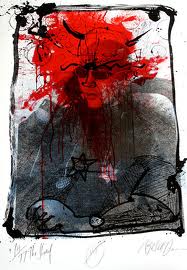
The Sheriff
1995


Revolution is often said to be the passion of youth.  And if one does not die in the revolution, one grows wiser with age.  If you study history, you will realize that even when the evil empire is overthrown, it is usually replaced by another empire that eventually becomes evil itself.  And the cycle continues.  The young want power and the old are unwilling to relinquish it.


And what you might add does all this have to do with art and writing?  Every generation or two there are revolutions in artistic taste and style.  The younger generation of artists challenges the older generation.  Today abstract expressionism is giving way to a resurgence of realism.  And tomorrow?  I won't even begin to predict.


I think Ralph Steadman has hit the nail on the head.  Stop worrying about changing the world, your spouse or even yourself.  Just create:  draw, paint and write. 

Tuesday, April 12, 2011

Richard Wollheim


"Learning appears as a way of staying young, perhaps of staying alive, and also as a way of growing up, perhaps facing death."


British Author, Philosopher


1923 - 2003


Life-long learning is a powerful habit to develop.  Learning something new keeps us in touch with our youth and helps us to stay active and alive.  What have you learned in the last week?  Who has taught you something new about yourself or your art?  


We experience the world through our senses — hearing, seeing, tasting, touching and smelling.  And what we experience teaches us much if we are paying attention and alert to the possibilities.  Did you smell the wind today?  Did you hear the approaching storm?  Do you taste the rain on your face?


From the time we are born until we die, our purpose is to learn, to grow, and to change.  Most learning does not occur in school and we don't stop learning once we graduate.  Cultivate a learning attitude.  Unfortunately, many people do not learn from their mistakes.  They are not willing to change and grow.  To be a great artist or writer, you must be constantly learning about the world in which we inhabit.


And when we face death, it will teach us much that we have forgotten.  Do not be afraid of death.  Understand that it is a gift.  It is a door through which we pass, a gate that leads to another world.

Wednesday, March 23, 2011

A. S. Neill


"Take from others what you want, but never be a disciple of anyone."


Scottish Educator, Writer


1883 - 1973


Life is about learning and everyone we encounter, whether in the virtual world or the physical world, has something to teach us, but no one is the master of all knowledge and wisdom.  No one deserves our devotion or discipleship.  We need to each independently investigate truth for ourselves.  We need to come to our own conclusions.  If we choose to blindly follow one person, we have failed ourselves.  We have let ourselves down.


From time to time in my life, I have wished I knew someone who had all the answers and I could sit at his feet and soak in his wisdom.  But I have never encountered that person and I have had to depend on my own thoughts and wisdom.  I have had to learn to investigate what truth is for myself.  And sometimes I make mistakes and sometimes I get it right.


People often feel they need heroes and gurus.  They keep looking for THE answer.  We put people on a pedestal and when we discovered their actions don't match their words, we tear them down.  We punish them for leading us a stray.  What we fail to realize is that there are no perfect people — no wise men sitting on a hill, only fools trying to get by.


As artists and writers, we must be careful not to worship other artists and writers, not to put them on pedestals.  We need to independently investigate what they have to teach and then make our own choices.  Truth is a slippery slope.  What we believe to be true today we may discover tomorrow was an illusion.


For your listening pleasure, here is one of my favorite Beatles song:  Fool on the Hill.


Monday, January 24, 2011

Samuel Taylor Coleridge


"Advice is like snow — the softer it falls, the longer it dwells upon, and the deeper it sinks into the mind."


English Poet


1772 - 1834


As creative leaders, we all receive advice — some good, some bad, and some dangerous.  Be careful of who you listen to.  The wrong advice can be damaging to your emotional and mental health as well as your creative output.  Good advice can keep you on track and motivated to keep producing creative work.  Dangerous advice is that which keeps us from fulfilling our potential.  We give up because some expert says we will never amount to anything.  


As creative leaders, we are also tempted to give advice.  Be careful.  The wrong advice can destroy a potential artist or writer.  I learned a valuable technique from a trainer many years ago.  He said if you are coaching someone on skill development, you should ask them two questions:  What did you do right?  and What will you do differently next time.


Most people know when they made a mistake or messed up, even if they don't consciously admit it.  And when they write or paint something, they are very critical of themselves.  So get them to focus on what they did right?  Have them focus on the good things.  Then ask them what they will do differently the next time they write a story or paint a picture?  Get the person to focus on how he can improve.   


Sunday, December 12, 2010

Kahlil Gibran


"Knowledge of the self is the mother of all knowledge.  So it is incumbent on me to know my self, to know it completely, to know its minutiae, its characteristics, its subtleties, and its very atoms.


Lebanese Poet/Artist


1883 - 1931


The Face of  Almustafa (The Prophet)


How well do you know yourself?  Do you know your strengths?  Your weaknesses?  Your blind spots? Most of us only partially know who we are and why we were born.  Life is an ongoing process of self-discovery.  And life is a process of becoming whom we are meant to be.  We can change who we are if we desire and are willing to change.  Other people can not change us, but they can teach us about ourselves.  There are things other people know about us that we do not know?  If we listen to them, we may hear the truth.  Even our enemies can teach us about ourselves.  Sometimes the people who irritate us the most have the most to teach us.  Often when we are irritated by the behavior we see in others, we are really irritated with ourselves because we behave the same way.  The better we know ourselves, the more honest our art will be and the better person we can become.

Saturday, December 11, 2010

Adolph Gottlieb


"Painting is self-discovery.  You arrive at the image through the act of painting."


American Painter


1903 - 1974


Three Discs on Chrome Ground (1969)


Any form of creative expression is an act of self-discovery if we are observant.  What do you learn about yourself in the process of painting?  What does your writing practice teach you about your obsessions — the themes of your life?  Do you hear your soul singing in your music?  What lessons are at the heart of the stories you tell?  We create works of art in order to understand ourselves whether we are eighteen or eighty-eight.  We create in order to understand our place in the worlds we inhabit.

Friday, December 3, 2010

Fyodor Dostoyevsky


"It is not the brains that matter most, but that which guides them: character, the heart, generous qualities, progressive ideas."


Russian Novelist


1821 - 1881


Think of the stories you have heard of intelligent, educated people who have done evil things.  Intelligence and even education do not make us good people.  It is what is in the heart that matters most.  Are you caring, compassionate and generous?  Your character and nature will show through.  That which lives in your heart will be visible in your art.  

Saturday, November 27, 2010

Nelson Mandela


"We are all meant to shine, as children do.  As we let our own light shine, we unconsciously give other people permission to do the same.  As we are liberated from our own fear, our presence automatically liberates others."


South African President/Anti-Apartheid Activist


1918 -


Do you let your light, your inner strength, shine through your creative work?  Each of us is special and unique.  There is not another person exactly like us in the universe.  We all have things in common, but at some level we are unique and special.  So let that which is you shine.  Don't hide your talent under a bushel basket.  Share it with others.  We each have a responsibility to help the people around us with our creativity and talent.  If we keep our light locked up inside us and hidden from the world, we have failed ourselves and others.

Tuesday, September 28, 2010

George Elliot


"What do we live for if it is not to make life less difficult for each other?"


English novelist


1819 - 1880


When it comes time to knock on those pearly gates and you look back across your life, what are you going to remember?  For most of us, it will be the people we've known and had some relationship with.  Will you have left this world a better place?  Will you have left the lives of those you love better?  Creative people, whether writers, painters or actors, often are known for their art, not their relationships.  I recently was reminded of this by the Jackson Pollock movie.  In his relationships with people, Pollock was a disaster.  I believe that an artist can be both creative and emotionally stable, but it takes working on relationships as much as we work on perfecting our art.

Monday, September 27, 2010

Bernard Malamud


"Without heroes, we are all plain people and don't know how far we can go."


American novelist


1914 - 1986


Who are your heroes?  Who are the people who inspire you?  We all need heroes.  Growing up my heroes were baseball players like Bob Gibson and Stan Musial.  In college my political heroes were Eugene McCarthy, Senator, and Martin Luther King, Jr., civil rights leader.  The poets who were my heroes in those college years were T. S. Elliot, Arthur Rimbaud and Theodore Roethke.  When I got into business, my hero was Tom Peters.  I modeled my speaking style after his.  Harry S. Truman, 33rd President, is another of my heroes.  Who are your heroes?  Who has inspired you?  Heroes are important because they role-model what we want to be.  They push us to go farther than we think possible.

Wednesday, September 8, 2010

Doug Larson


"Wisdom is the reward you get for a lifetime of listening when you would have preferred to talk."


1926 -


While talking can sometimes help us understand ourselves, listening helps us understand others.  And by understanding others, we will better understand ourselves.  If we listen to the words of others, they will teach us about life — both what do to and what not to do.  We probably learn more from the failures of others than we do from their successes.  As writers, storytellers and artists, we need to understand other people.  The better we understand people, the more realistic and truthful our art will be.