Showing posts with label drawing. Show all posts

Wednesday, June 8, 2011

Jonathan Hull


"Without art; without paintings, books, sculpture and music, the human soul would be quite impenetrable, don't you think?"


— Jonathan Hull


American Novelist, Journalist


Can you imagine a world without art?  No books to read.  No writers of poetry.  No paintings.  No sculpture.  No music.  No theater.  No movies.  No stories.  Could you live in such a world?  And yet there are people who live lives without creating and appreciating the world of art.  They have no interest in books, paintings or music.  I for one could not live in such a world. 


I have a strong need to create a work of art.  To write a poem.  To sing a song.  To paint a picture.  To tell a story.  Without creative work, my soul would die a slow death.  Celebrate the fact that you have the ability to appreciate great works of art.  Believe that you have the skill to create great works of art.

Saturday, May 14, 2011

Vincent Van Gogh


Self-Portrait

1889


"If you hear a voice within you say, 'You cannot paint,' then by all means paint and that voice will be silenced."


— Vincent van Gogh


Dutch Painter


1853 - 1890


Most of us have a voice inside that plants seeds of doubt in our hearts.  "You can't paint.  You can't write.  You can't draw.  You can't speak.  You can't sing...."  The list goes on and on.  Today we call it self-talk.  One expert says that 75% of what we say to ourselves is negative.   We need to silence that negative voice by proving him wrong.  Don't listen to that negative voice that is determined to make you fail.  Keep writing.  Keep painting.  Keep drawing.


When I teach people how to be better speakers, I talk about that second voice sitting on their shoulders.  When I first started speaking, I heard two voices — the one coming out of my mouth and the one sitting on my shoulder.  The one was positive and upbeat.  The second was nervous and negative.  The more often I spoke, the less vocal the second voice became.  Today I rarely hear that negative voice.  And when I do, I give him a quick kick and he is gone.


And the same is true of my writing.  I used to hear the voice of doubt shouting in my ear.  Today, I can barely hear him mumble.  And when he does appear, he is skin and bones and dressed in rags.  Soon he will be homeless.


The First Steps, After Jean Francis Millet

(January 1890)


I have written two poems in response to this painting, The First Steps, by Van Gogh:  A Father's Dream from the point of view of the father and A Mother's Grief from the point of view of the mother.  Just click on the titles.


Monday, May 2, 2011

Ralph Steadman


"What I used to do with a passion, foolishly and vainly imagining I would change the world for the better, I no longer tolerate in myself or anyone else.  But draw, always draw — and WRITE."


British Artist, Writer


1936 -


Have you ever dreamed of changing the world — making it a better place?  Unfortunately, most people have very little influence on the world at large.  And with the one person that we do have influence over — ourselves — we usually lack the discipline for long-term change.  Have you ever tried to change a spouse or a significant other?  It rarely works.  I have often heard of wrecked marriages resulting from one person trying to change the other.


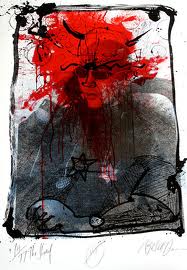
The Sheriff
1995


Revolution is often said to be the passion of youth.  And if one does not die in the revolution, one grows wiser with age.  If you study history, you will realize that even when the evil empire is overthrown, it is usually replaced by another empire that eventually becomes evil itself.  And the cycle continues.  The young want power and the old are unwilling to relinquish it.


And what you might add does all this have to do with art and writing?  Every generation or two there are revolutions in artistic taste and style.  The younger generation of artists challenges the older generation.  Today abstract expressionism is giving way to a resurgence of realism.  And tomorrow?  I won't even begin to predict.


I think Ralph Steadman has hit the nail on the head.  Stop worrying about changing the world, your spouse or even yourself.  Just create:  draw, paint and write. 

Saturday, April 23, 2011

Kimon Nicolaides


"Learning to draw is really a matter of learning to see — to see correctly — and that means a good deal more than merely looking with the eye."


American Artist, Teacher, Author


1891 - 1938


The arts involve the five senses of seeing, hearing, touch, taste and smell.  We understand the world in which we live through these five senses.  How we see the world impacts our ability to draw, paint and write.  


When I arrived home yesterday, my wife asked if I had noticed a hat hanging on one of my favorite wood statues.  I had not.  She said the hat had been there for several weeks.  My visual intake of the world around me is very selective.  I never notice the clothes people wear and I could not tell you what you were wearing yesterday.  Yet, if I visit a place I have not seen in five years, I will recognize the buildings.  


I put very little description of places and people in my writing.  And when I am reading a book with a lot of description, I tend to skip over it.


On the other hand, I am very auditory.  I can hear the slightest change in the tone of a voice.  I can hear the softest of sounds.  I cannot sleep with the radio or TV playing.  But I cannot sing worth a lick.  In fact, some people would say I am tone deaf.


How do the five senses impact your painting or writing?  Are you a visual person?  An auditory person?  How about the senses of touch, taste and smell?

Thursday, April 7, 2011

James Galvin


"Let us begin with a simple line,


Drawn as a child would draw it,


To indicate the horizon...."


American Poet


1951 -


In drawing and writing, we almost always begin with the line.  The line turns into letters which turn into words which turn into sentences.  And eventually the sentences become poems, short stories and novels.  The same is often true is art.  The line becomes an eye, then a nose and soon a face.  The drawing begins as a simple line much like what a child starts with.  The artist then transforms that line into a beautiful portrait, landscape or abstract painting.


When we begin the canvas and the paper are blank, empty, without much meaning.  As creative artists our job is transform that paper or that canvas into more.  To create something out of a simple line.  To communicate our vision of the world through a simple line joined with other simple lines — one built on another.


The same can be said about life.  Each moment we live is like a simple line.  We build a life through living each moment to the fullest.  And millions of moments become a life lived.  


Here is the poem, Art Class, by James Galvin.


Art Class


By James Galvin


Let us begin with a simple line,


Drawn as a child would draw it,


To indicate the horizon,


More real than the real horizon,


Which is less than line,


Which is a visible abstraction, a ratio.


The line ravishes the page with implications


Of white earth, white sky!


The horizon moves as we move,


Making us feel central.


But the horizon is an empty shell —


Strange radius whose center is peripheral.


As the horizon draws us on, withdrawing,


The line draws us in,


Requiring further lines,


Engendering curves, verticals, diagonals,


Urging shades, shapes, figures...


What should we place, in all good faith,


On the horizon? A stone?


An empty chair? A submarine?


Take your time.  Take it easy.


The horizon will not stop abstracting us.

Friday, February 18, 2011

Theodore Roethke


"Being, not doing, is my first joy."


— Theodore Roethke


American Poet


1908 - 1963


I must confess that being is very difficult for me.  For years I have been caught up in the culture of doing.  Setting goals and working to achieve my goals.  I find it very difficult to sit and just be.  I must at the very least doodle and who knows maybe my doodles will one day be famous.  We can dream can't we!  If I go on vacation, it often takes me a week to relax and forget my day job.  But I still feel I must be doing something.  Writing.  Drawing.  Producing something.  Rarely can I just be.


How about you?  Are you caught up in the culture of doing or have you learned like Roethke to enjoy just being?


Here is my favorite Theodore Roethke poem.  I love the first three lines.  This is a poem to be read outloud.  Listen to the interaction of sounds.


The Waking


I wake to sleep, and take my waking slow.

I feel my fate in what I cannot fear.

I learn by going where I have to go.


We think by feeling. What is there to know?

I hear my being dance from ear to ear.

I wake to sleep, and take my waking slow.


Of those so close beside me, which are you?


God bless the Ground! I shall walk softly there,


And learn by going where I have to go.


Light takes the Tree; but who can tell us how?

The lowly worm climbs up a winding stair;

I wake to sleep, and take my waking slow.


Great Nature has another thing to do

To you and me, so take the lively air,

And, lovely, learn by going where to go.


This shaking keeps me steady. I should know.

What falls away is always. And is near.

I wake to sleep, and take my waking slow.


I learn by going where I have to go.

Tuesday, February 8, 2011

Louise Nevelson


"Another thing about creation is that every day it is like it gave birth, and it's always kind of innocent and refreshing.  So it's always virginal to me, and it's always a surprise."


American Artist


1899 - 1988


Sky Cathedral

(1958)


Does your creative work surprise you?  Do you find yourself full of joy when you are working?  Are you excited about the possible outcome?  Creative work should be fun and bring us moments of happiness.  If it is a struggle for you to create, then you need to work on freeing the creative juices.  These days I can sit down at my desk and write without hesitation.  I just start writing and don't worry about the outcome.  And most times I have no idea where the story will go or what the characters will say.  The same with art.  I pick up the pen and start drawing.  I have muzzled that voice inside that always wants to criticize and tell me how terrible I am.  I don't give him a chance to scream at me.  I am learning to enjoy the moment.


Wednesday, January 26, 2011

Katharine Graham


"To love what you do and feel that it matters — how could anything be more fun?"


American Publisher


1917 - 2001


Do you love to paint?  Do you love to write?  Do you love to act?  Do you love to draw?  What is your passion?  If you do not enjoy writing or singing or painting, then maybe it is time to get out of the creative business and find something you love to do.   The creative world is difficult and if you don't have fun being creative, you will feel like you have been hit by truck. 


What we as creative leaders do is very important.  We touch people's lives and help them feel better about themselves.  We solve problems and show the world a better way.  We bring beauty and ideas into the world.  We help people escape their mundane worlds for a short time.  We inspire people to be better than they are.  We give hope where there is none.  We help people visit new worlds and experience new places.

Tuesday, January 4, 2011

Gail Godwin


"Within the last year I have discovered I can compose whole paragraphs in my head and find them waiting, intact, next morning."


American Novelist


1937 - 


Our minds are very powerful and capable of doing more than we imagine.  In a recent New York Times Book Review essay on the lives of aging writers, Godwin, 73, tells us that she is now able to compose paragraphs in her mind and retain them — something she was unable to do in her youth.  She remembers as a young writer hearing Jorge Luis Borges tell his audience at the Iowa Writer's Workshop that blindness taught him to compose his stories in his head.  I know of poets who compose poems in their minds and are able to recite them from memory.


Many young writers and artists feel that if they are not successful by the time they turn forty, they have failed.  Yet, writing and painting is a learning process.  Creativity does not rest with only the young.  Some of us don't get our first wind until we are over sixty.  I remember reading the story many years ago of a writer who published his first novel in his thirties and his second in his eighties.


While Gail Godwin is best known for her thirteen novels, she has also composed music with Robert Starer and keeps colored pencils at her bedside.  On her website Godwin says that she will often draw before she goes to sleep.  She says: "I also draw when I am baffled by some aspect of the character.  Making a visual image of that character in action almost always reveals something new."

Thursday, November 25, 2010

Eric Hoffer


"The hardest arithmetic to master is that which enables us to count our blessings."


American Philosopher/Writer


1902 - 1983


We should give thanks daily for the gifts that we have been given.  The world we live in can be a difficult, negative place and yet we must find a way to celebrate the positive, to believe in that which is good and precious.  As creative leaders our gifts and talents are many.  I am thankful that I can type, that I can read, that I can write, that I can create.  Sometimes it is the small things that are most important.  


Give thanks for what you have been given.  Develop an attitude of gratitude.  Every day write down ten things for which you are grateful.  The choice is yours.  Focus on what you have, not what you don't have.  Don't like that picture you painted?  Don't think you have much skill in drawing?  Don't despair.  Focus on your talent for color or your insight into human nature.  Honor the gifts that you have.  Appreciate your strengths. Celebrate life.  

Sunday, November 7, 2010

Piet Mondrian


Composition #2 Piet Mondrian

"Everyone knows that even a single line may convey an emotion."


Dutch Painter


1872 - 1944


The line is one of the smallest elements of a drawing or a painting.  The line is the beginning of what is to be.  And in that beginning the line conveys the emotion to come, the story to be told.  All art begins some where.  For the artist it is the line.  For the writer it is the word.  For the musician it is the note.  And the line becomes the skeleton, the core of what is created.


I recently discovered the drawings of Michael Kirby.  He has the powerful ability to convey emotion with simple lines.  Check out his blog at:


Sunday, October 10, 2010

Henri Matisse


"I don't paint things.  I only paint the difference between things."


French Artist


1869 - 1954


What attracts you?  What do you gravitate towards?  Do you paint children?  Dogs?  Landscapes?  Mountains?  What do you write about?  Crime?  Troubled families?  Other worlds?  Aliens?   God appears a lot in my writings.  Not intentionally on my part.  He just pops up.  When I doodle and draw, masks appear.  We are all attracted to certain things.  The deeper question is why are you attracted to what you paint and write about.  What motivates and inspires your art?  Only you can answer that question.

Wednesday, September 1, 2010

Henri Matisse


"The character of a face in a drawing depends not upon its various proportions, but upon a spiritual light which it reflects."


— Henri Matisse

French Artists


1869 - 1954


Like an artist or a novelist, we all need to see beyond the surface characteristics of the human face.  We need to see the individual person who lives within.  We have been taught not to judge a book by its cover, yet how many times do we still do it.  Inside every person, beyond the hair and the clothes, is something very special.  Sometimes it takes work to find that person because the person has hid himself behind so many masks that he does not even know who he is.  And the same can be said of ourselves.  How many masks would you have to take off before the light within you would shine through?