A story should be rooted in reality. The reader needs to be able to relate the characters to the world that he knows. Consider the novel, Watership Down, by Richard Adams. The story is about rabbits and yet, we identify with them because of their human characteristics. Dorothy Dunnett was a writer of historical novels who did immense research to place her stories in historical reality. But facts are never enough. It is in the imagination that the story takes wings and flies far from the facts to spin a story that touches the minds and hearts of the readers.
Have you rooted your stories in the reality? Have you used your imagination to carry the stories to the heavens? How about your paintings? Is there something in the work with which we can identify? Does the painting carry us beyond the facts into another world?
"Success is stumbling from failure to failure with no loss of enthusiasm."
— Winston S. Churchill
British Artist, Historian, Writer and Statesman
1874 - 1965
Churchill painting (1946)
Churchill was a man who faced both failure and success multiple times throughout his life. He did poorly in school, had a speech impediment, grieved the death of a child, smoked Havana cigars, and was captured and spent time as a prisoner of war in South Africa. He wrote a novel, two biographies, three volumes of memoirs and several books of history. He was awarded the Nobel Prize for Literature in 1953. He painted hundreds of paintings and several now hang in museums. He served as the Prime Minister of Great Britain twice. So when Churchill speaks of failure and success we all should listen.
We all face both failure and success in our lives. How we respond to what life hands us will tell others a lot about our character. When you suffer the humiliation of defeat and rejection, how do you respond? Do you become angry? Do you seek revenge? Do you withdrawal into depression? When you receive some honor and are applauded by everyone, how do you respond? Does the recognition go to your head and you become arrogant? Do you act like a diva and expect everyone to do your bidding? How we deal with the successes and failures of life tells us a lot about ourselves.
"Between beauty of expression and power of expression there is a difference of function. The first aims at pleasing the senses, the second has a spiritual vitality which for me is more moving and goes deeper than the senses."
— Henry Moore
British Sculptor
1898 - 1986
Which is more important the beauty of what is said or the power of what is said? I agree with Moore that the impact of what is communicated is more important than the beauty with which it is communicated. It doesn't matter whether you are talking art, literature or music. Too much emphasis in our culture has been put on beauty. Form often wins out over substance. For me, the substance of the art matters more. The spiritual aspect of the communication is more important than the surface beauty. Some works of art have both beauty and substance. But if I must choose, I choose substance over beauty. When you look at a painting, listen to music or read a novel, what is more important to you: what is said or how it is said?
"What I used to do with a passion, foolishly and vainly imagining I would change the world for the better, I no longer tolerate in myself or anyone else. But draw, always draw — and WRITE."
Have you ever dreamed of changing the world — making it a better place? Unfortunately, most people have very little influence on the world at large. And with the one person that we do have influence over — ourselves — we usually lack the discipline for long-term change. Have you ever tried to change a spouse or a significant other? It rarely works. I have often heard of wrecked marriages resulting from one person trying to change the other.
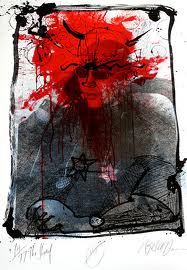
The Sheriff 1995
Revolution is often said to be the passion of youth. And if one does not die in the revolution, one grows wiser with age. If you study history, you will realize that even when the evil empire is overthrown, it is usually replaced by another empire that eventually becomes evil itself. And the cycle continues. The young want power and the old are unwilling to relinquish it.
And what you might add does all this have to do with art and writing? Every generation or two there are revolutions in artistic taste and style. The younger generation of artists challenges the older generation. Today abstract expressionism is giving way to a resurgence of realism. And tomorrow? I won't even begin to predict.
I think Ralph Steadman has hit the nail on the head. Stop worrying about changing the world, your spouse or even yourself. Just create: draw, paint and write.
The Study After Velazquez's Portrait of Pope Innocent X (1953)
Life is mysterious and full of questions with few answers. The job of the creative leader is not to provide the answers but to help his audience to explore the questions at even deeper levels. Life at its core is spiritual in nature. The artist connects the spiritual with the mysterious and fills the heart with joy. Our challenge has writers, artists and creative leaders is to reach deep within our spirits and share the magical mystery of the heart.
What spiritual questions are you exploring in your art? Your writing? Your acting? Your dancing? What is the mysterious hidden within your creation? What is the song sung from your heart?
How much is your art connected to nature? Do you spend time observing the shapes and patterns within nature? Do you study nature and learn from it?
When I spent seven years writing and studying haiku, I spent time connecting with the physical world around me — listening to nature. I would take walks and write haiku. Even those of us who live in cities are a part of nature. Here is a haiku that I wrote while walking around Chicago.
downtown Chicago
a squirrel buries apples —
warm autumn sun
As creative leaders, we must look for inspiration in nature whether we write novels, paint abstract paintings or compose music. Nature has much to teach us about ourselves and the world in which we live. Watch the rabbits playing in your backyard. Enjoy the beauty of a sunset. Take a walk and feel the snowflakes on your cheeks.
"Picture and poem bear the same relationship to each other as beauty does in man and woman: the point of meeting where the two are identical is the supreme perfection."
Having spent over 35 years writing poetry and now painting for the last five years, I am fascinated by the point where poetry and painting meet. Dante Gabriel Rossetti was trained both as a poet and a painter and spent a lifetime writing poetry and painting pictures. He once said: "If any man has any poetry in him he should paint it, for it has all been said and written." And yet Rossetti saw himself more as a poet than a painter. He also said: "Painting being — what poetry is not — a livelihood — I have put my poetry chiefly in that form." And I would have to agree with his last point. While it may be difficult to make a living being a painter, it is even more difficult making a living from writing poetry.
Is there a poem inside you asking to be let out? Is there a painting inside you begging to be set free? I strongly encourage painters to write poetry and short stories. I think every poet and novelist should pick up a brush and spend a few hours painting. Remember it is not about being financially successful. It is about releasing your inner creativity.
Here is a poem by Rossetti:
The Honeysuckle
I plucked a honeysuckle where
The hedge on high is quick and thorn,
And climbing for the prize, was torn,
And fouled my feet in quag-water;
And by the thorns and by the wind
The blossom that I took was thinn'd,
And yet I found it sweet and fair.
Thence to a richer growth I came,
Where, nursed in mellow intercourse,
The honeysuckles sprang by scores,
Not harried like my single stem,
All virgin lamps of scent and dew.
So from my hand that first I threw,
Yet plucked not any more of them.
Here is a video on YouTube showing some of the paintings of Rossetti:
"All my life, I have from time to time gone back to paint because it gave me a form of delight that words can never give. Perhaps the joy in words goes deeper and it is for that reason more unconscious. The conscious delight is certainly stronger in paint."
Creative expression is not limited to one form. Poets paint. Painters write. Actors paint. What do you find joy in? Words? Paint? Acting? Don't limit yourself to one form or medium. Explore and expand your horizons. Creativity is open and free. Perfectionism is narrow and limiting. We sometimes don't try things because we want to be perfect. Perfectionism is about technique. Creativity is about expression. If we allow ourselves to be confined by technique, our creativity will harden and shrink. Creativity frees the soul and opens up new worlds. Technique imprisons the soul and we die a slow death. What do you take delight in? What brings you joy?
Discipline is one of the keys to being an artist or a writer. One needs to work every day. People often say: 'I work when I am inspired.' If you wait until you are inspired, you will be waiting a long time. If you work whether you are inspired or not, you will find that soon inspiration will become a constant companion. Work opens up the creative spirit and the inspiration flows. So my message is simple: work every day even if it is for only 15 minutes.